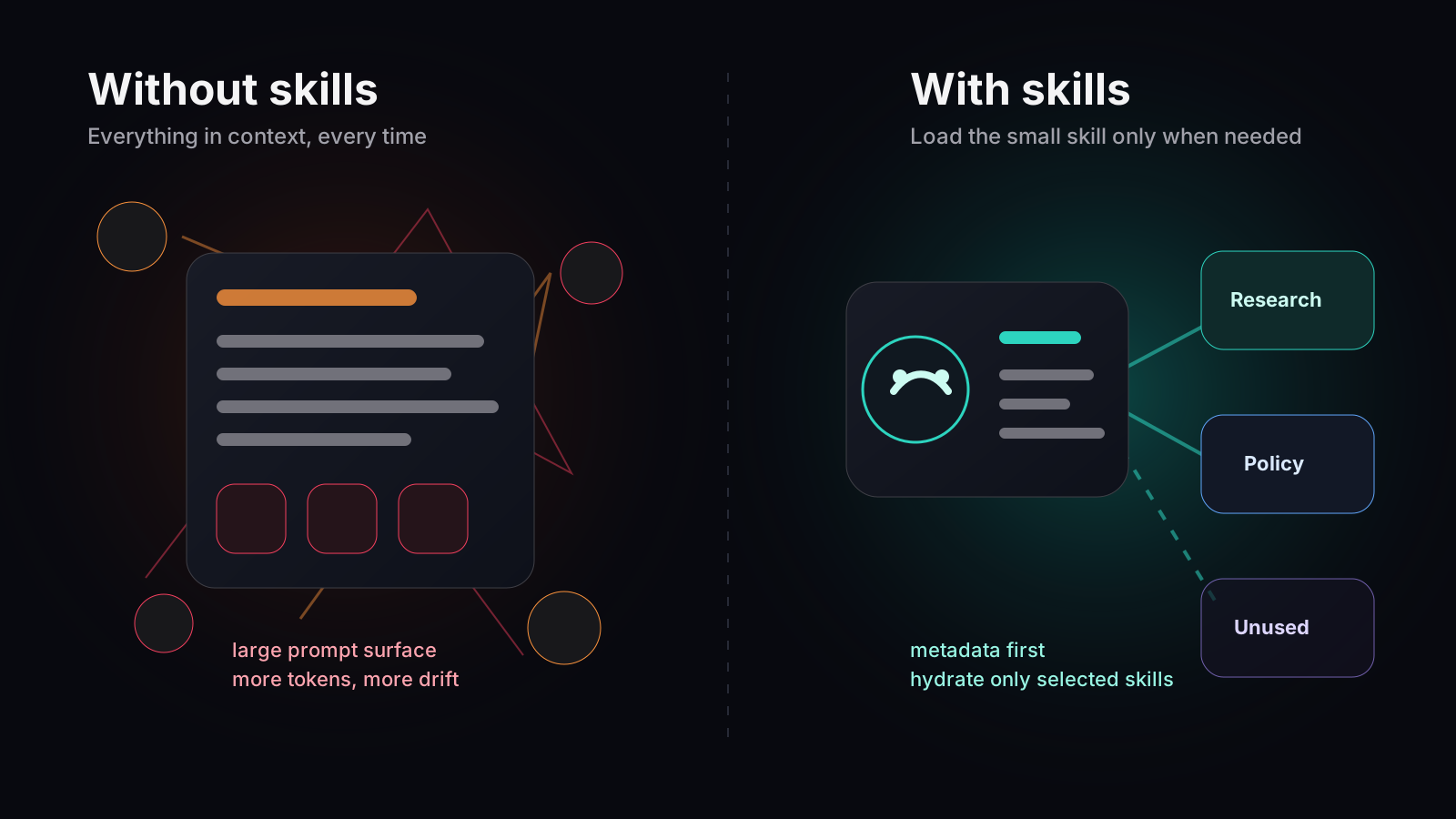
How We Made Agent Skills Feel Free
A practical look at lazy-loaded agent skills: metadata first, full files only when needed, and no persistent VM required.
Read
Real strategies sales teams are using with Yast agents to automate prospecting, enrich leads, personalize outreach, and accelerate their pipeline.

Sales teams are under constant pressure to do more with less. More outreach, more personalization, more follow-ups, and more pipeline, all with the same headcount. The teams that are pulling ahead are not working harder. They are deploying AI agents that handle the repetitive work while humans focus on building relationships and closing deals.
Here are five concrete ways sales teams are using Yast to accelerate their pipeline.
The first thing most sales reps do when they get a new lead is research. They check LinkedIn, visit the company website, read recent news, look up funding rounds, and try to piece together a picture of the prospect. This process takes 15 to 30 minutes per lead, and it scales terribly.
Yast agents do this research in seconds. A typical lead enrichment agent connects to LinkedIn (via enrichment APIs), Crunchbase, the company's website, and the CRM. It pulls together a comprehensive profile: company size, industry, recent funding, key decision-makers, technology stack, recent hires, and relevant news.
The agent writes a concise research brief and attaches it to the CRM record. By the time a rep opens the lead, the homework is already done.
One sales team we work with reports that their reps save an average of 12 hours per week on research. That time now goes directly into conversations with qualified prospects.
Generic cold emails do not work. Everyone knows this, but writing genuinely personalized emails for hundreds of prospects is not realistic without help.
Yast agents solve this by combining the research from step one with proven email templates and real-time personalization. The agent analyzes the prospect's role, company, industry, and recent activity to craft messages that reference specific, relevant details.
The key difference between Yast-generated outreach and template-based mail merge is context awareness. A Yast agent does not just insert a company name into a template. It might reference a blog post the prospect published last week, a product launch their company announced, or a challenge specific to their industry.
Because Yast agents self-improve, the outreach gets better over time. The agent tracks which emails get responses, which subject lines perform best, and which personalization strategies resonate with different audience segments. After a few weeks, the agent's email performance typically exceeds what reps produce manually.
Follow-up is where deals die. Research shows that 80% of sales require five or more follow-ups, but most reps give up after two. The problem is not laziness. It is that tracking dozens of follow-up timelines across hundreds of prospects is cognitively overwhelming.
Yast agents manage follow-up sequences automatically. The agent monitors CRM records for prospects that have not responded, checks the appropriate follow-up interval, and sends contextually relevant follow-up messages. Each follow-up is different and references the previous message, recent company news, or a new angle on the value proposition.
The agent can also escalate stalled deals. If a prospect has not engaged after the full sequence, the agent can notify the rep, suggest a different approach, or route the lead to a colleague who has a connection to the prospect's company.
Sales managers spend hours each week reviewing pipeline reports, identifying at-risk deals, and coaching reps on next steps. Much of this analysis is pattern recognition that agents handle naturally.
A Yast pipeline intelligence agent connects to the CRM and runs on a daily schedule. It analyzes every open deal, checking for warning signs: deals that have been in the same stage too long, deals where the primary contact has gone quiet, deals where a competitor was recently mentioned, and deals with upcoming close dates but missing next steps.
The agent compiles a daily briefing and delivers it to the team's Slack channel. Each deal gets a health score and a specific recommended action. Managers can review the briefing in five minutes instead of spending an hour building reports.
Teams using this approach report catching at-risk deals two to three weeks earlier than they did with manual reviews.
Knowing what your competitors are doing gives you an edge in every sales conversation. But monitoring competitor activity manually, checking their websites, reading their blog posts, tracking their job listings, and following their social media, is a full-time job.
Yast agents automate competitive intelligence gathering. The agent monitors competitor websites for changes, tracks new job postings that might signal product direction, follows news mentions, and analyzes pricing page updates. It compiles a weekly competitive intelligence report and delivers it to the sales team.
When a rep is about to join a call with a prospect who is also evaluating a competitor, they can ask the agent for a real-time comparison. The agent pulls the latest competitive data and generates talking points specific to that competitor's weaknesses relative to your product.
Each of these five use cases delivers value individually. But the real power comes from combining them. When lead research feeds into personalized outreach, which flows into intelligent follow-ups, which is informed by pipeline intelligence and competitive monitoring, you get a sales machine that continuously improves.
The agents share context. The research agent's findings inform the outreach agent's personalization. The follow-up agent draws on pipeline intelligence to adjust its timing and messaging. The competitive intelligence agent's findings show up in the pipeline briefing when a competitor is involved in a deal.
Most sales teams start with lead enrichment because it delivers immediate, visible time savings. Once reps experience the quality of automated research, they quickly ask for outreach automation. From there, the expansion to follow-ups, pipeline intelligence, and competitive monitoring happens naturally.
The entire setup takes less than a day. You describe each agent in plain English, connect it to your CRM and communication tools, and set the appropriate triggers. There is no code to write, no workflows to build, and no IT tickets to file.
If your sales team is spending more time on research and data entry than on actual selling, Yast agents can flip that ratio.
A practical look at lazy-loaded agent skills: metadata first, full files only when needed, and no persistent VM required.

Yast is live: describe AI agents in plain English, connect your tools, and let them improve after every run.
No single AI model is best at everything. Learn how Yast routes tasks to GPT, Claude, Gemini, Deepseek, and Mistral for optimal results.

Describe what you need. Yast builds the agent, connects your tools, runs it on autopilot, and it gets smarter every time.
Get Started