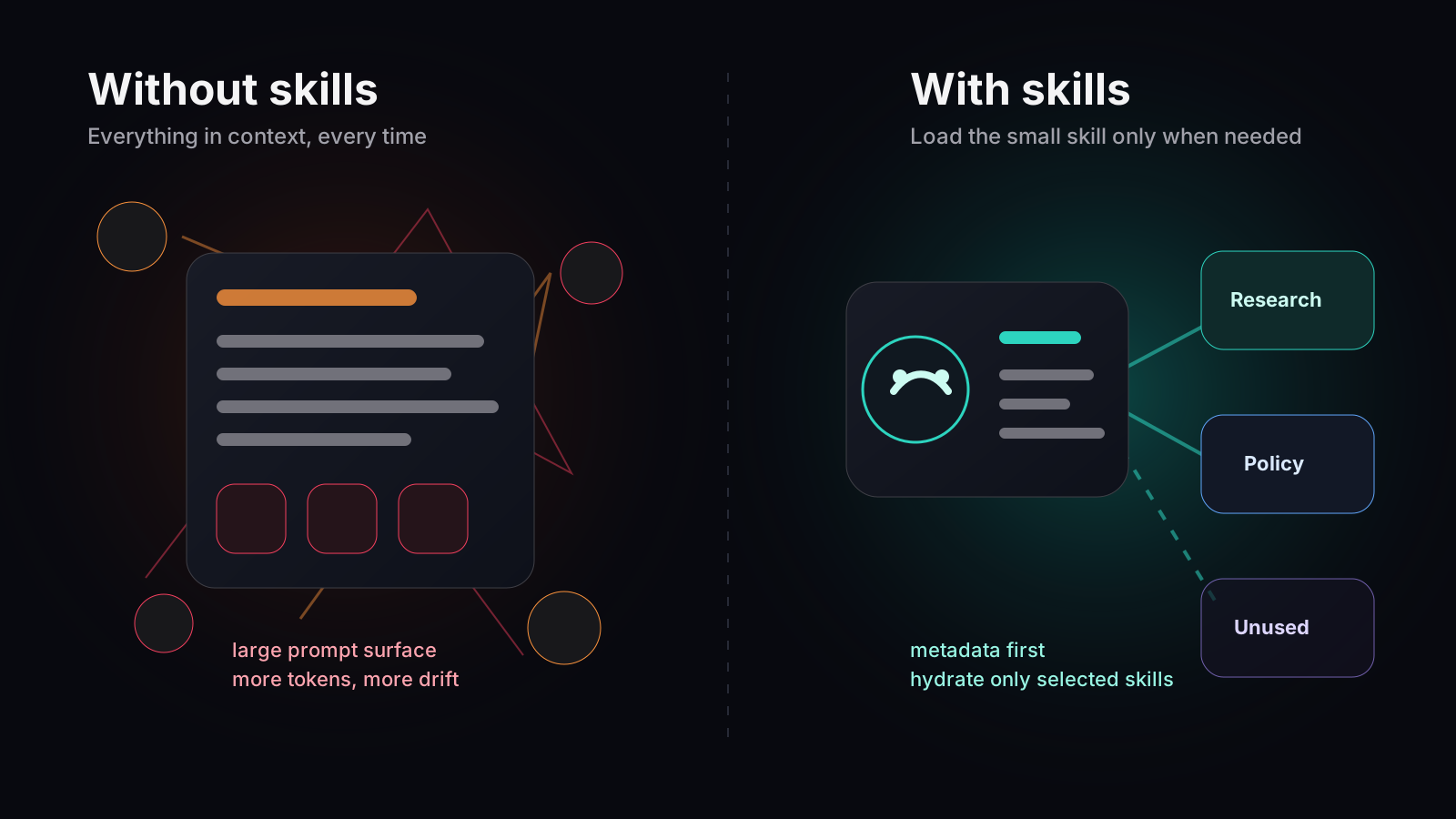
How We Made Agent Skills Feel Free
A practical look at lazy-loaded agent skills: metadata first, full files only when needed, and no persistent VM required.
Read
No single AI model is best at everything. Learn how Yast routes tasks to GPT, Claude, Gemini, Deepseek, and Mistral for optimal results.

There is a persistent myth in the AI space that you should pick one model and use it for everything. Teams choose GPT-4o or Claude and route every task through it, regardless of whether that model is the best fit. This is like using a Swiss Army knife for every job when you have an entire toolbox available.
At Yast, agents are multi-model by default. A single agent can use different models for different steps in its execution, automatically selecting the best model for each task. This article explains why this matters and how it works.
Modern language models are not interchangeable. Each model family has distinct strengths that emerge from differences in training data, architecture, and optimization objectives.
**Claude** excels at long-form writing, nuanced analysis, and tasks that require careful reasoning over extended contexts. When a Yast agent needs to draft a detailed report, write a persuasive proposal, or analyze a complex document, Claude consistently produces the best results.
**GPT-4o** is exceptionally strong at structured data extraction, function calling, and tasks that require precise adherence to output formats. When an agent needs to parse an API response, extract specific fields from unstructured text, or generate structured JSON, GPT-4o is typically the best choice.
**Gemini** brings strong multimodal capabilities and excels at tasks that involve images, long documents, or cross-referencing multiple sources of information. Agents that process screenshots, analyze visual content, or work with very long context windows benefit from Gemini.
**Deepseek** offers strong reasoning capabilities at a lower cost point, making it an excellent choice for intermediate processing steps where the output does not need to be customer-facing. Tasks like data classification, simple summarization, and pattern matching can be routed to Deepseek without sacrificing quality.
**Mistral** provides fast inference with solid quality for tasks that need to execute quickly. When an agent has a time-sensitive step, like checking a condition or making a simple decision, Mistral's speed advantage is meaningful.
Yast's execution engine includes a model router that selects the appropriate model for each step in an agent's execution plan. The routing decision considers several factors.
Task Type: The router maintains a capability map that associates task types with model strengths. Writing tasks route to Claude. Extraction tasks route to GPT-4o. Visual analysis routes to Gemini. The capability map is continuously updated based on benchmark results and real-world performance data.
Output Requirements: If the step needs to produce structured output (JSON, CSV, specific formats), the router favors models with strong structured generation capabilities. If the step produces free-form text, the router favors models with strong writing quality.
Context Length: Some steps require processing large amounts of context. The router considers the input size and selects a model with an appropriate context window. For very long inputs, Gemini's extended context capabilities make it the natural choice.
Cost and Latency: Not every step requires the most capable (and expensive) model. The router considers the step's importance within the overall execution and routes lower-stakes steps to more cost-effective models. A step that classifies a support ticket into one of five categories does not need the same model as a step that drafts a customer-facing response.
Historical Performance: The router tracks which models have performed best for similar tasks in the past. This feedback loop means the routing improves over time, just like the agents themselves.
Consider a sales outreach agent that runs daily. Here is how multi-model routing might handle its execution:
Step 1: Fetch new leads from HubSpot. (No model needed, this is a tool call.)
Step 2: For each lead, research the company by analyzing their website. Gemini processes the web content due to its strength with long documents and mixed media.
Step 3: Extract structured data from the research: company size, industry, technology stack, recent news. GPT-4o handles this because of its precision with structured extraction.
Step 4: Classify the lead's priority based on fit criteria. Deepseek handles this classification task cost-effectively.
Step 5: Draft a personalized outreach email for high-priority leads. Claude writes the email because of its superior writing quality and ability to strike the right tone.
Step 6: Format the email and add it to the sending queue. GPT-4o handles the formatting step due to its structured output reliability.
Each step uses the model that will produce the best result for that specific task. The total cost is lower than routing everything through a single premium model, and the quality is higher than routing everything through a single budget model.
Multi-model routing delivers significant cost savings compared to single-model approaches. In our benchmarks across thousands of agent runs, multi-model routing reduces AI inference costs by 35% to 55% compared to routing everything through GPT-4o, with no measurable decrease in output quality.
The savings come from routing intermediate processing steps to more cost-effective models. In a typical agent execution, only 20% to 30% of steps actually benefit from a top-tier model. The remaining steps perform identically (or nearly so) on less expensive models.
For teams running agents at scale, hundreds of executions per day, these savings add up to thousands of dollars per month.
Multi-model routing also improves reliability. If one model provider experiences an outage or degraded performance, the router can redirect tasks to alternative models. When OpenAI has a slow day, Claude-destined tasks continue unaffected, and tasks that would normally route to GPT-4o can fall back to Gemini or another capable model.
This provider diversity is a form of infrastructure resilience that you do not get when locked into a single model provider.
The AI model landscape changes rapidly. New models launch every few weeks, and existing models receive updates that change their capabilities. Yast's model router is designed to adapt to this pace of change.
When a new model is released, our team evaluates it across our standard benchmark suite covering writing, extraction, reasoning, coding, and classification tasks. If the model excels in any category, it is added to the routing map for those task types.
This evaluation happens within days of a model's release. Agents built on Yast automatically benefit from new models without any reconfiguration. If Anthropic releases a new Claude version with better reasoning capabilities, your agents start using it for reasoning tasks as soon as our evaluation confirms the improvement.
While automatic routing is the default, Yast gives operators full visibility and control. The execution log shows which model was used for each step and why. If you disagree with a routing decision, you can pin specific steps to specific models.
Some teams prefer to set model policies at the organization level. For example, an organization might require that all customer-facing text be generated by Claude, regardless of what the router would choose. These policies override the automatic routing for the specified cases.
Teams that commit to a single model are making a bet that one model will be the best at everything, forever. History suggests this is a bad bet. The model landscape is competitive and shifting. Today's leader in writing might be tomorrow's runner-up. A new entrant might surpass everyone at structured reasoning.
By building on a multi-model architecture, you insulate your agents from the volatility of the model market. Your agents always use the best available model for each task, regardless of which provider built it or when it was released.
The future of AI is not one model to rule them all. It is the right model for the right task, selected automatically and improved continuously.
A practical look at lazy-loaded agent skills: metadata first, full files only when needed, and no persistent VM required.

Yast is live: describe AI agents in plain English, connect your tools, and let them improve after every run.
Marketing teams spend hours building reports. Yast agents pull data from every source, generate analysis, and deliver polished reports automatically.

Describe what you need. Yast builds the agent, connects your tools, runs it on autopilot, and it gets smarter every time.
Get Started