How We Made Agent Skills Feel Free
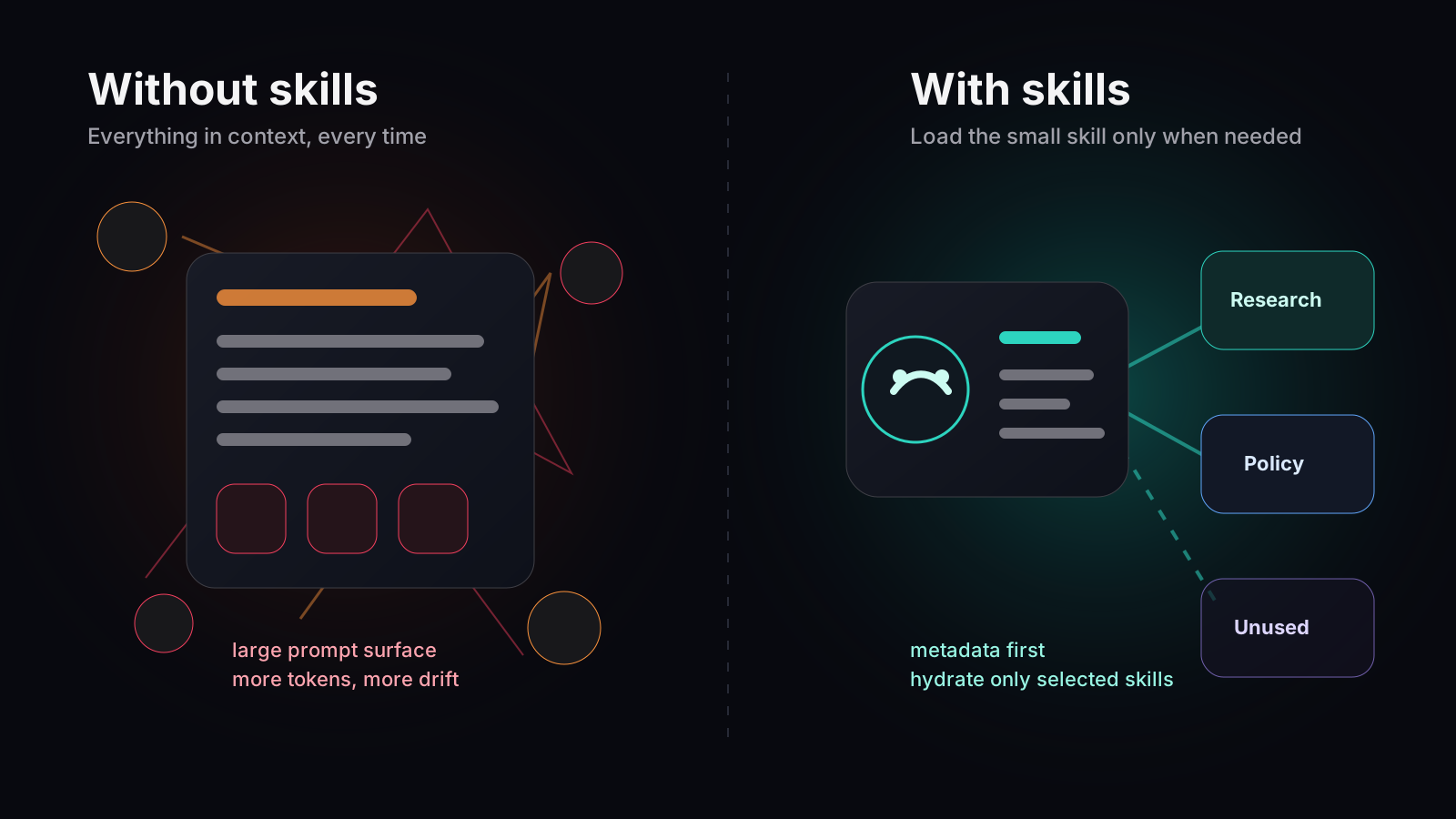
A practical look at lazy-loaded agent skills: metadata first, full files only when needed, and no persistent VM required.
Read
The engineering behind agents that survive API changes, model updates, and infrastructure shifts without manual intervention.

Building an AI agent that works today is straightforward. Building one that still works reliably a year from now is a genuinely hard engineering problem. APIs change, models get deprecated, rate limits shift, and the tools your agent depends on will inevitably update their schemas, endpoints, and authentication mechanisms.
At Yast, we have invested heavily in durability. We want agents deployed today to keep running for years without manual intervention. This article explains the engineering decisions that make that possible.
Consider what happens to a typical AI automation over time. The agent was built against version 3 of an API. Six months later, the API provider ships version 4, deprecates two endpoints, renames three fields, and changes the pagination format. The automation breaks silently, producing incorrect results or failing outright.
Now multiply that across every integration an agent uses. An agent connected to five tools has five potential breaking points. An agent connected to fifteen tools has fifteen. Over a year, the probability that at least one integration will change in a breaking way approaches certainty.
Traditional automation platforms put the burden of handling these changes on the user. You get an error notification, you investigate the failure, you update the workflow, and you hope the fix does not break something else. This maintenance burden is why most automations have a half-life of about eight months.
The first line of defense against integration drift is Yast's tool abstraction layer. Agents do not interact directly with raw API endpoints. Instead, they interact with Yast's tool adapters, which provide a stable interface on top of potentially unstable APIs.
When HubSpot changes their API, Yast's HubSpot adapter is updated to accommodate the change. Every agent that uses HubSpot continues to work without modification because the adapter absorbs the difference. The agent still says "fetch leads from HubSpot" and gets leads back in the same format, regardless of what changed on HubSpot's end.
We maintain adapters for over 1,000 tools, and our integration team monitors API changelogs, deprecation notices, and breaking changes across all of them. When a change is detected, the adapter is updated and tested before the change goes live.
AI models have even shorter lifecycles than APIs. OpenAI has deprecated multiple model versions in the past year alone. An agent built on GPT-3.5 needs to transition smoothly to GPT-4, GPT-4o, or whatever comes next.
Yast agents are model-agnostic by design. The agent's description and behavior are defined independently of any specific model. The execution engine selects the appropriate model at runtime based on the task requirements, available models, and performance history.
When a model is deprecated, the execution engine automatically routes to a suitable replacement. When a new model launches, it enters a testing phase where it handles a subset of tasks in parallel with the existing model. If it performs better, it gradually takes over. If it performs worse, it is sidelined.
This means agents built on Yast today will automatically benefit from better models tomorrow without any reconfiguration.
Long-running agents, especially those with many steps, need to survive infrastructure interruptions. A server restart, a network partition, or a cloud provider hiccup should not cause an agent to start over from the beginning.
Yast implements execution checkpointing at the step level. After each step completes, the agent's state is persisted. If execution is interrupted, it resumes from the last completed step rather than starting from scratch.
This checkpointing is particularly important for agents that run multi-hour workflows. A monthly reporting agent that collects data from seven sources, generates analysis, and compiles reports might run for 15 minutes or more. Without checkpointing, any interruption would waste all of that work.
External APIs impose rate limits, and those limits change. An agent that worked fine making 100 API calls per minute might start failing when the provider reduces the limit to 60. Traditional automations handle this poorly, often hitting the limit and failing repeatedly until a human intervenes.
Yast's execution engine includes a rate limit manager that tracks current limits for every tool, implements intelligent backoff when limits are approached, and distributes requests across available capacity. When an agent's workload exceeds a tool's rate limit, the engine queues requests and processes them at the maximum sustainable rate rather than failing.
The rate limit manager also learns from experience. If a tool consistently throttles requests at a certain rate, the manager proactively slows down before hitting the limit, avoiding the latency penalty of 429 responses.
When an external API returns data in an unexpected format, most automations crash. Yast agents validate the schema of every API response against expected patterns. When a mismatch is detected, the agent attempts to map the new schema to the expected format.
This self-healing capability handles the majority of minor API changes: renamed fields, added optional fields, changed data types, and reordered responses. For major breaking changes that cannot be auto-mapped, the agent flags the issue and continues with degraded functionality rather than failing completely.
Every aspect of an agent's configuration is versioned: the description, the tool connections, the evaluation criteria, and the adaptation state. If a change causes problems, operators can roll back to any previous version with a single click.
This versioning also enables safe experimentation. You can create a new version of an agent, test it against a subset of tasks, compare its performance to the current version, and promote it to production only when you are confident it is an improvement.
Our goal is agents that you set up once and never have to think about again. They should adapt to API changes, benefit from model improvements, recover from infrastructure issues, and maintain their performance indefinitely.
We are not fully there yet, but the architecture is designed for this outcome. Every engineering decision we make is evaluated against the question: "Will this agent still work two years from now?" If the answer is no, we find a different approach.
Durability is not a feature you can bolt on after the fact. It has to be designed into every layer of the system from the start, and that is exactly what we have done.
A practical look at lazy-loaded agent skills: metadata first, full files only when needed, and no persistent VM required.

Yast is live: describe AI agents in plain English, connect your tools, and let them improve after every run.

No single AI model is best at everything. Learn how Yast routes tasks to GPT, Claude, Gemini, Deepseek, and Mistral for optimal results.

Describe what you need. Yast builds the agent, connects your tools, runs it on autopilot, and it gets smarter every time.
Get Started