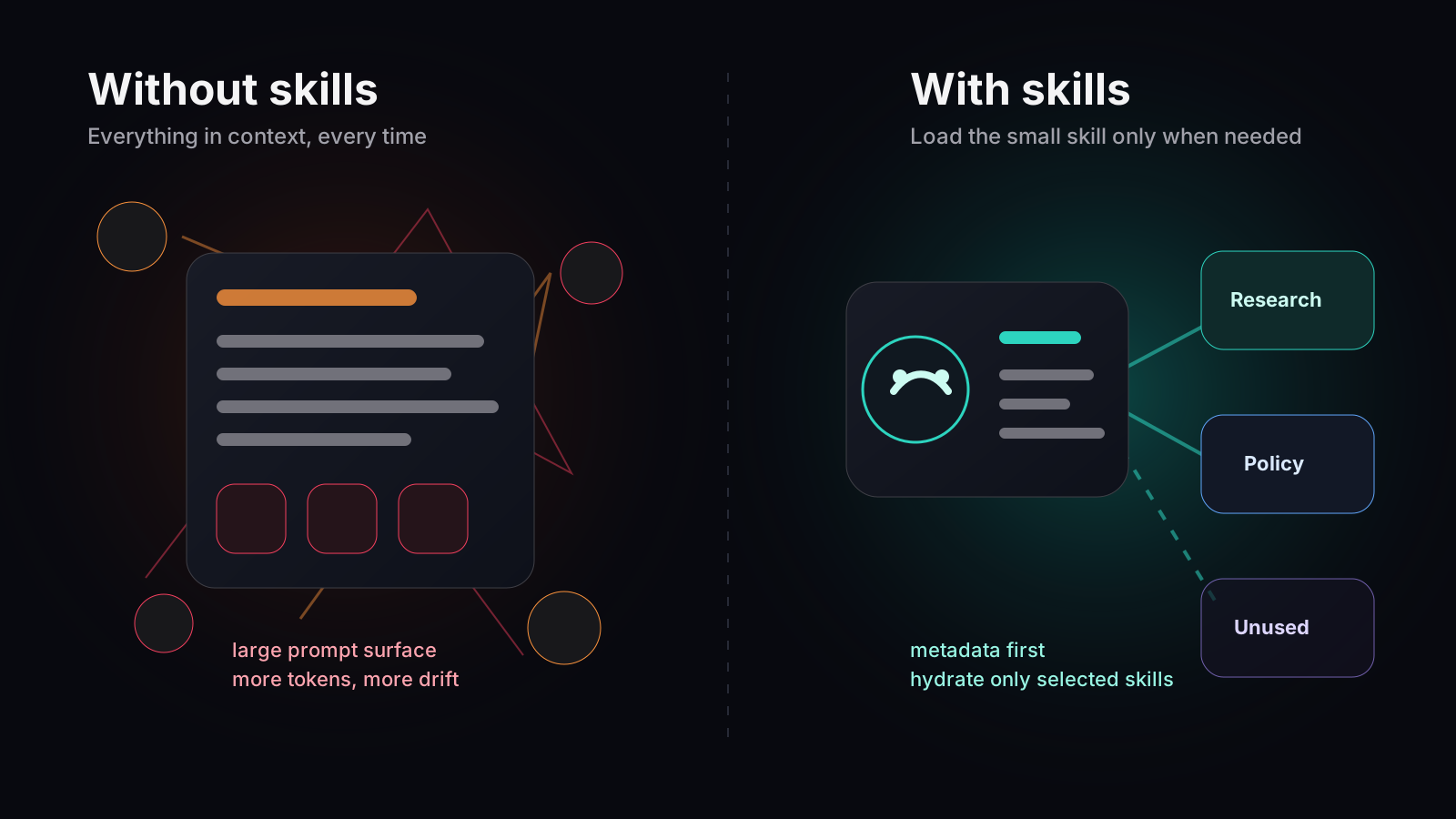
How We Made Agent Skills Feel Free
A practical look at lazy-loaded agent skills: metadata first, full files only when needed, and no persistent VM required.
Read
Marketing teams spend hours building reports. Yast agents pull data from every source, generate analysis, and deliver polished reports automatically.

Every Monday morning, marketing teams across the world sit down to build the same reports they built last week. They log into Google Analytics, export the data. They pull numbers from HubSpot. They check the ad spend in Google Ads and Meta. They compile everything into a slide deck or spreadsheet, add commentary, and send it to leadership. The whole process takes three to five hours, and it produces exactly the kind of work that should not require human effort.
Yast agents eliminate this grind. Teams describe their reporting requirements in plain English, connect the relevant data sources, and schedule the agent to run weekly. The agent handles everything from data collection to narrative generation to delivery.
Marketing reporting suffers from a specific set of problems that make it particularly well suited for AI agents.
Data Fragmentation: Marketing data lives in a dozen tools. Website analytics, CRM, email platform, ad platforms, social media tools, SEO tools, and content management systems all contain pieces of the picture. Assembling a complete view requires logging into each tool, exporting data, and normalizing formats manually.
Repetitive Analysis: Most reporting follows the same analytical framework week after week. You compare this week to last week, this month to last month, this quarter to the same quarter last year. You identify the metrics that moved significantly, investigate why, and summarize the implications.
Narrative Overhead: Numbers alone do not tell a story. Leadership wants to know what happened, why it happened, and what the team plans to do about it. Writing this narrative is time-consuming and often the most dreaded part of the reporting process.
A typical marketing reporting agent on Yast connects to five to ten data sources. Here is an example configuration:
The agent's description might read: "Every Monday at 7 AM, compile a weekly marketing performance report. Pull website traffic and conversion data from Google Analytics. Pull lead and pipeline data from HubSpot. Pull ad spend and performance from Google Ads and Meta Ads Manager. Pull email campaign metrics from Mailchimp. Compare all metrics to the previous week and the same week last year. Identify the three most significant changes and explain their likely causes. Generate an executive summary and deliver it to the #marketing-reports Slack channel."
The agent connects to each of these tools, fetches the relevant data at runtime (consistent with our zero data storage architecture), performs the analysis, and generates the report.
Yast reporting agents produce structured, readable reports that are ready for stakeholders without editing. A typical weekly report includes:
An executive summary paragraph that highlights the most important takeaways in plain language. This is not a list of numbers. It is a narrative that explains what happened and what it means.
A metrics dashboard section with week-over-week and year-over-year comparisons for key metrics: sessions, conversion rate, leads generated, MQLs, pipeline created, ad spend, cost per lead, and revenue attributed to marketing.
A deep-dive section on the three most significant metric movements. If organic traffic dropped 15%, the agent investigates potential causes: were there ranking changes for key terms? Did a competitor launch competing content? Was there a technical issue on the site?
A channel performance breakdown that compares the effectiveness of different marketing channels and flags any that are underperforming relative to their spend.
An action items section that recommends specific follow-up actions based on the data. If cost per lead on Google Ads increased significantly, the agent might recommend reviewing keyword bids and ad copy.
The same architecture extends to any reporting cadence or format. Teams use Yast agents for monthly board reports that synthesize a full month of marketing performance into a five-page narrative. They use them for campaign post-mortems that analyze the performance of a specific campaign across all channels and compare it to historical benchmarks.
Some teams run daily pulse reports, which are short summaries delivered to Slack each morning. These cover overnight changes in key metrics and flag anything that needs immediate attention. The daily pulse agent is typically much simpler than the weekly report agent, focusing on anomaly detection rather than comprehensive analysis.
Because Yast agents are configured in plain English, marketing teams can easily customize their reporting. Want to add a competitor tracking section? Just update the agent description. Want to change the delivery from Slack to email? Modify one line. Want the report to include a different metric? Describe it.
This flexibility is crucial for marketing teams, whose reporting requirements evolve constantly. New campaigns launch, new channels are tested, and leadership priorities shift. Updating an agent's description takes minutes, compared to the hours required to reconfigure a traditional BI dashboard or reporting template.
The self-improvement loop is particularly powerful for reporting agents. Over time, the agent learns which insights leadership finds valuable and which are noise. If the team consistently ignores the social media section but always engages with the pipeline analysis, the agent adjusts its emphasis accordingly.
The agent also improves its anomaly detection. In the early runs, it might flag every metric change above 5% as significant. Over time, it learns the normal variance for each metric and only flags changes that are genuinely unusual. A 10% swing in daily social media engagement might be normal noise, while a 10% change in conversion rate is a legitimate signal.
Marketing teams using Yast for reporting consistently report saving 15 to 20 hours per week across the team. But the time savings are only part of the value. The reports are also more consistent, more comprehensive, and delivered on time every single week. There are no missed Monday reports because someone was on vacation or because the week was too busy.
The quality of analysis improves too. An agent that has access to all data sources simultaneously can identify cross-channel patterns that a human analyst might miss when examining each tool separately. When organic traffic drops and paid conversions spike, a human might report these as separate trends. The agent recognizes the correlation and investigates whether the organic decline is driving the paid increase.
The fastest path to value is starting with your most painful report. Pick the one that takes the longest, involves the most data sources, and causes the most frustration. Describe its requirements to a Yast agent, connect the data sources, and schedule it.
Most teams have their first automated report running within a day. The first version will not be perfect, but after two to three weeks of runs and refinement, it will be better than the manual version it replaced.
A practical look at lazy-loaded agent skills: metadata first, full files only when needed, and no persistent VM required.
Yast is live: describe AI agents in plain English, connect your tools, and let them improve after every run.

No single AI model is best at everything. Learn how Yast routes tasks to GPT, Claude, Gemini, Deepseek, and Mistral for optimal results.

Describe what you need. Yast builds the agent, connects your tools, runs it on autopilot, and it gets smarter every time.
Get Started