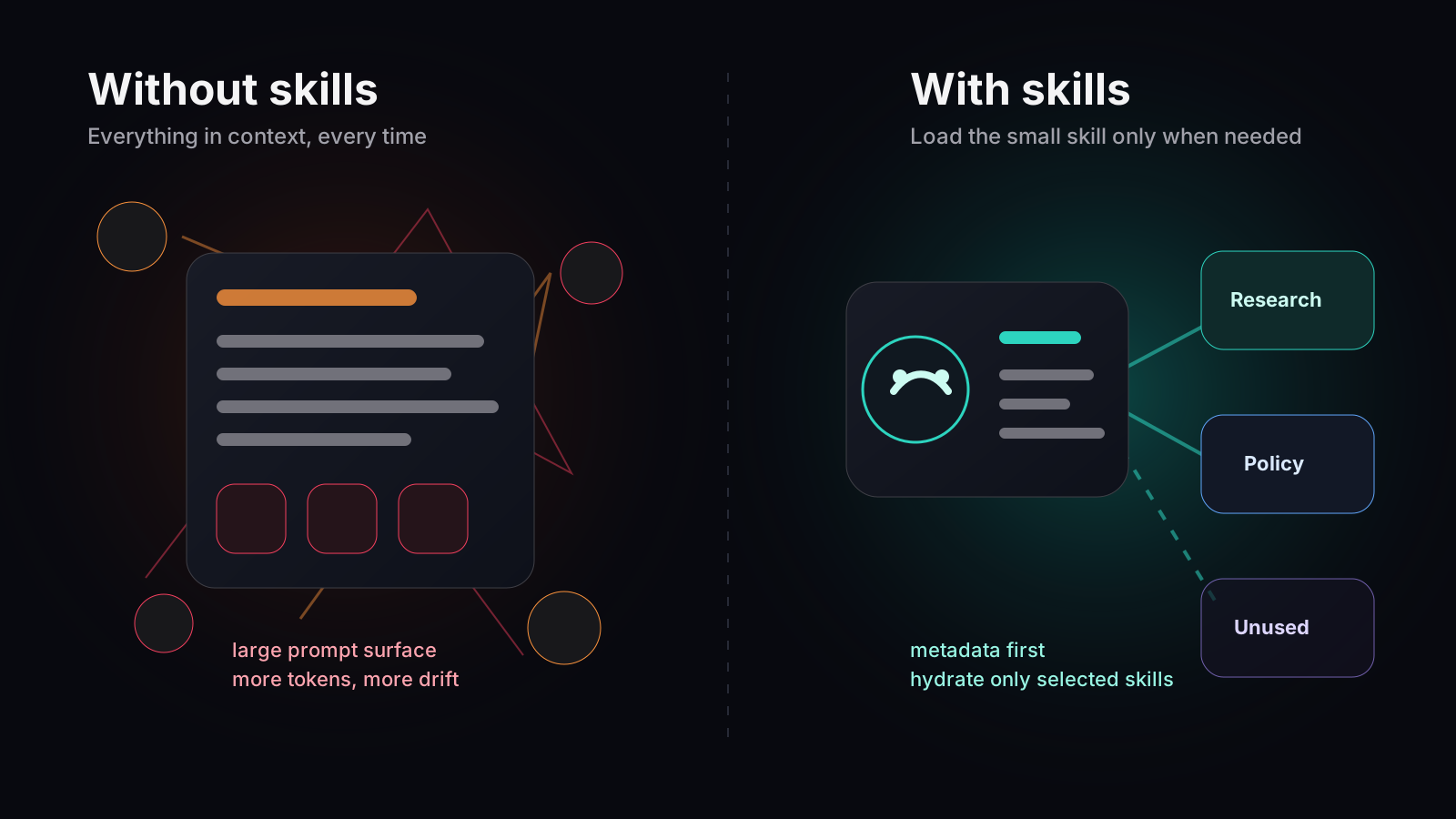
How We Made Agent Skills Feel Free
A practical look at lazy-loaded agent skills: metadata first, full files only when needed, and no persistent VM required.
Read
A deep dive into the evaluation loops, feedback mechanisms, and architecture that allow Yast agents to get better after every run.

The phrase "self-improving AI" gets thrown around a lot, usually in marketing copy that never explains the mechanism. At Yast, self-improvement is not a buzzword. It is a concrete engineering system with observable results. This article explains exactly how it works.
Every Yast agent runs through a four-phase cycle: plan, execute, evaluate, and adapt. The first two phases are what most agent platforms offer. You give the agent a task, it makes a plan, and it executes that plan step by step. The last two phases are where Yast diverges.
After execution completes, the agent enters the evaluation phase. It compares its output against the success criteria defined in the agent description. These criteria can be explicit ("the email must include the prospect's company name and a relevant case study") or implicit (general quality heuristics that Yast applies to every run).
The evaluation produces a structured scorecard. Each dimension of the output receives a rating: accuracy, completeness, relevance, and efficiency. The scorecard also includes specific observations about what worked and what did not.
The adaptation phase takes the evaluation scorecard and translates it into behavioral changes. This is not fine-tuning a model. Yast agents improve through a combination of prompt refinement, step reordering, tool selection optimization, and example caching.
Prompt Refinement: When the evaluation identifies a recurring weakness, the system adjusts the prompts used in future runs. If an agent consistently produces emails that are too formal for a casual audience, the adaptation layer adds tone guidance to the agent's working instructions.
Step Reordering: Agents sometimes discover that changing the order of operations produces better results. For example, an agent that enriches leads might learn that checking LinkedIn before querying the CRM yields more complete profiles. The adaptation layer captures these orderings and applies them to future runs.
Tool Selection Optimization: When multiple tools can accomplish the same task, the agent tracks which tool produces better results in specific contexts. Over time, it develops preferences. It might learn that one email-finding API is more reliable for enterprise domains while another works better for small businesses.
Example Caching: Successful outputs are cached as reference examples. When the agent encounters a similar task in the future, it can draw on these examples to guide its approach. This is particularly effective for tasks with consistent structure, like generating reports or drafting responses.
Automated evaluation handles the bulk of the improvement process, but human feedback is a powerful accelerator. Yast provides a simple thumbs-up/thumbs-down mechanism on every agent output. When a user marks an output as poor, the system records the specific output, the context, and the rating.
This human signal carries more weight than automated evaluation in the adaptation layer. A single human correction can shift behavior immediately, while automated signals typically require several observations before triggering a change.
Teams can also provide detailed feedback through annotations. If an agent drafts a proposal and the user edits three paragraphs before sending it, Yast can analyze the diff and incorporate those preferences into future runs.
A system that changes its own behavior introduces risk. An agent could theoretically "improve" itself into a worse state through a feedback loop of bad evaluations. Yast prevents this through several mechanisms.
First, adaptations are applied incrementally. No single evaluation can drastically change an agent's behavior. Changes are small, targeted, and reversible.
Second, every adaptation is logged and versioned. If an agent's performance degrades after an adaptation, the system can automatically roll back to a previous state. Operators can also manually revert changes through the dashboard.
Third, there is a stability threshold. Once an agent reaches a high performance level, the adaptation rate slows down. The system becomes more conservative about changes, requiring stronger signal before making adjustments.
The Yast dashboard includes a performance timeline for every agent. You can see how accuracy, completion rate, and efficiency have changed across runs. Most agents show a steep improvement curve in the first 20 to 30 runs, followed by a gradual refinement phase.
We have observed agents that started at 60% accuracy on complex tasks reach 90% or higher within three weeks of regular use. The improvement is particularly dramatic for tasks with clear success criteria and consistent structure.
Traditional automation tools do not improve. A Zapier workflow runs the same way on day one as it does on day one thousand. If the workflow has a problem, a human has to identify it and fix it manually.
Fine-tuning a language model is another approach, but it requires collecting training data, running expensive training jobs, and deploying new model versions. It is slow, costly, and requires ML expertise.
Yast's approach sits between these extremes. It achieves meaningful improvement without the overhead of model training, and it does so continuously rather than in discrete cycles. The agent gets better every day, automatically.
We are actively working on cross-agent learning, where insights from one agent can benefit others in the same organization. If your sales outreach agent discovers an effective approach, your customer success agent could apply similar patterns to its own communication tasks.
Self-improvement is the core of what makes Yast different. It is not just about running tasks. It is about running them better, every single time.
A practical look at lazy-loaded agent skills: metadata first, full files only when needed, and no persistent VM required.
Yast is live: describe AI agents in plain English, connect your tools, and let them improve after every run.
No single AI model is best at everything. Learn how Yast routes tasks to GPT, Claude, Gemini, Deepseek, and Mistral for optimal results.

Describe what you need. Yast builds the agent, connects your tools, runs it on autopilot, and it gets smarter every time.
Get Started