How We Made Agent Skills Feel Free
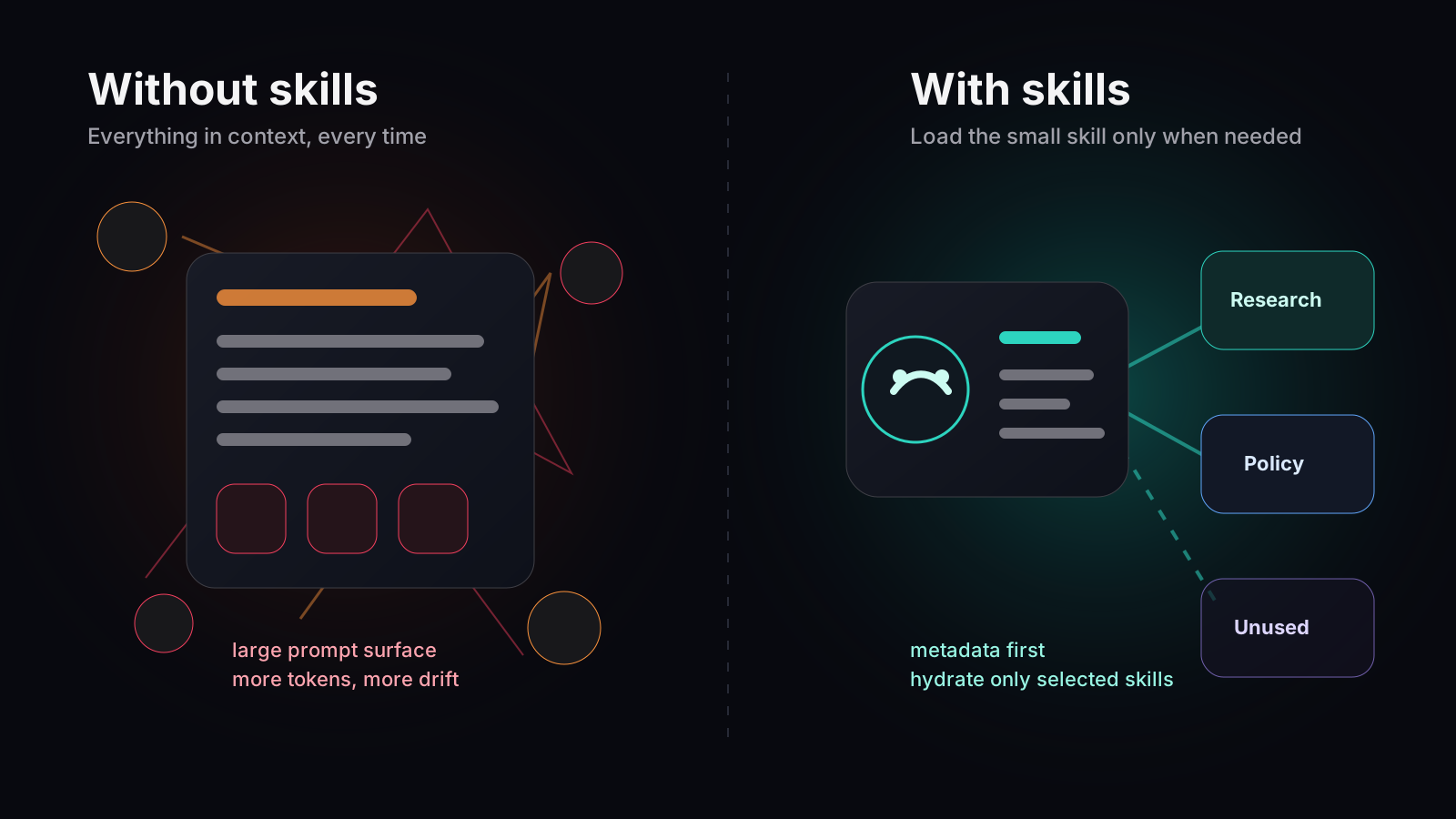
A practical look at lazy-loaded agent skills: metadata first, full files only when needed, and no persistent VM required.
Read
Meet the platform where you describe agents in plain English, connect them to your tools, and watch them improve after every single run.
Most AI agent platforms ask you to do one of two things: write code or drag boxes around a flow builder. Both approaches share the same fundamental problem. They force you to think like an engineer when what you really want is to describe what you need and have it happen.
Yast takes a different approach entirely. You describe your agent in plain English, connect it to the tools your team already uses, and set it loose. The agent figures out the steps, executes them, and then does something no other platform offers: it evaluates its own performance and gets better the next time it runs.
The idea for Yast came from a frustration we kept running into. Every team we talked to had the same story. They had tried building automations with Zapier, Make, or n8n. Simple two-step workflows were fine. But the moment they needed something with real decision-making, conditional logic, or multi-step reasoning, those tools fell apart.
On the other side of the spectrum, developer-focused frameworks like LangChain and CrewAI gave teams power but demanded engineering resources that most companies could not spare. The gap between "I can describe what I want" and "I can build what I need" was enormous.
Yast exists to close that gap. We wanted a platform where a sales ops manager could build an agent that researches prospects, enriches CRM records, drafts personalized outreach, and schedules follow-ups, all without writing a single line of code or hiring a contractor.
Building an agent on Yast starts with a plain-English description. You tell the agent what its job is, what tools it can access, and what a successful outcome looks like. There is no visual flow builder because the agent determines its own execution path based on the task at hand.
Under the hood, Yast decomposes your description into an execution plan. Each step in the plan is a discrete action: fetch data from HubSpot, analyze a spreadsheet, send a Slack message, update a GitHub issue. The agent chains these actions together, handling errors, retries, and branching logic automatically.
You connect the agent to any combination of over 1,000 integrations. These include CRMs like HubSpot and Salesforce, communication tools like Slack and Gmail, development platforms like GitHub and Jira, databases, spreadsheets, and dozens of other categories.
The feature that truly sets Yast apart is the self-improvement loop. After every run, the agent evaluates its own performance against the success criteria you defined. Did it complete all the steps? Was the output accurate? Did it take longer than expected? Were there any errors?
This evaluation feeds back into the agent's behavior. Over time, agents learn which approaches work best for specific scenarios. An agent that sends cold outreach emails will learn which subject lines get responses. An agent that triages support tickets will get better at categorizing edge cases.
The improvement is not abstract. You can see it in the evaluation dashboard, which tracks accuracy, completion rate, and performance metrics across every run. Teams tell us their agents reach peak performance within two to three weeks of deployment, and they continue to refine themselves after that.
Yast is not locked to a single AI provider. Your agents can use GPT-4o, Claude, Gemini, Deepseek, Mistral, and other models depending on which is best suited for the task. A single agent might use Claude for long-form writing, GPT-4o for structured data extraction, and Gemini for analyzing images.
This multi-model approach means your agents always use the best tool for the job. When a new model launches that excels at a particular task, Yast can route work to it without any changes on your end.
Agents built on Yast are not confined to a web dashboard. You can deploy them to Slack, Microsoft Teams, Telegram, and Discord. Your team interacts with agents in the same channels where they already work, which means adoption happens naturally rather than requiring a new tool in the stack.
You can also trigger agents via cron schedules for recurring tasks, event-based triggers for reactive workflows, or on-demand through a simple API call.
This launch is just the beginning. We are building toward a future where every team has a fleet of AI agents handling the repetitive, time-consuming work that keeps people from focusing on what they do best. Agents that do not just follow instructions, but learn, adapt, and genuinely improve.
We are excited to share Yast with the world. If you have been waiting for AI agents that actually deliver on the promise of automation without the overhead of engineering, this is it.
A practical look at lazy-loaded agent skills: metadata first, full files only when needed, and no persistent VM required.
Yast is live: describe AI agents in plain English, connect your tools, and let them improve after every run.

No single AI model is best at everything. Learn how Yast routes tasks to GPT, Claude, Gemini, Deepseek, and Mistral for optimal results.

Describe what you need. Yast builds the agent, connects your tools, runs it on autopilot, and it gets smarter every time.
Get Started