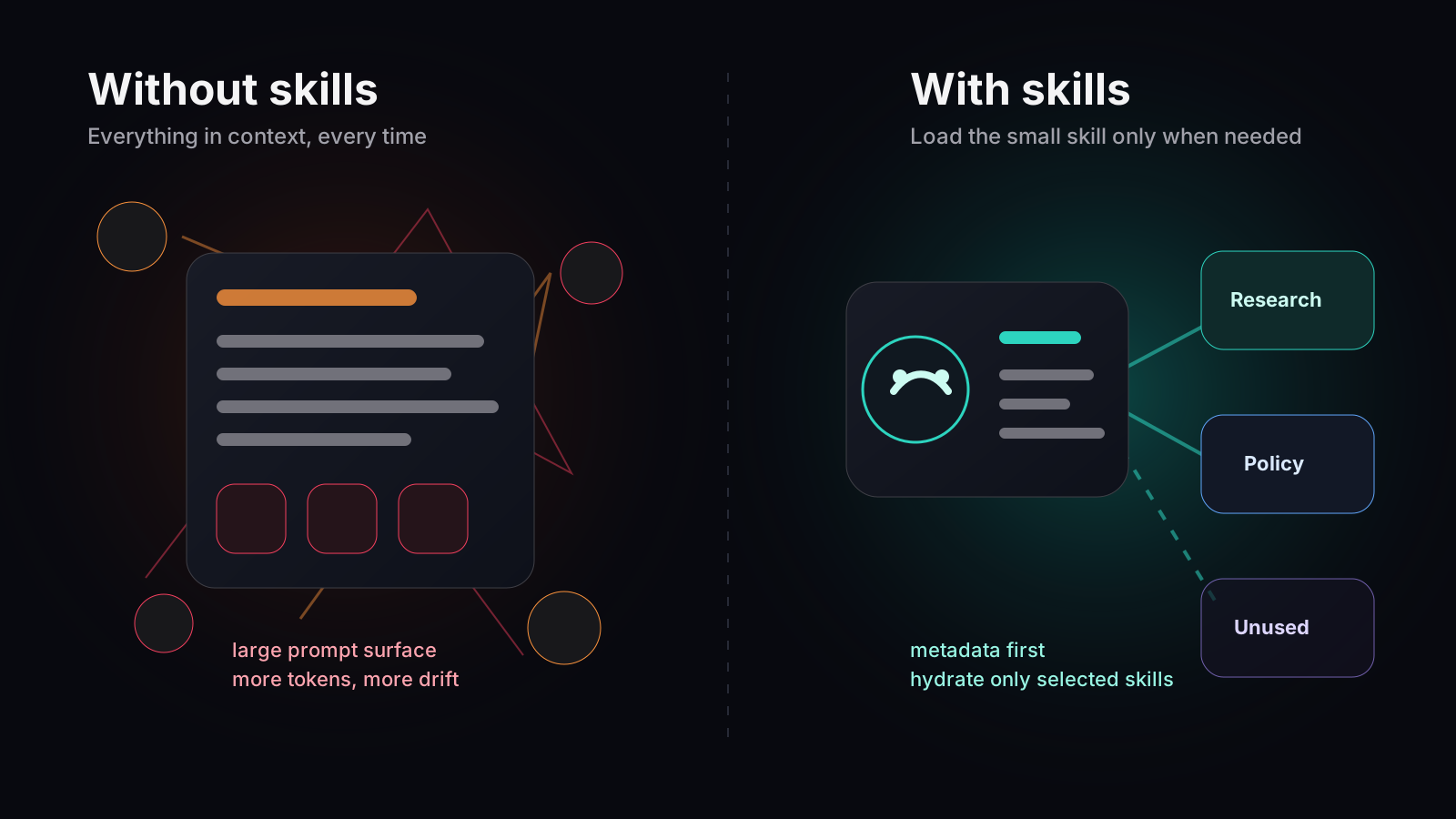
How We Made Agent Skills Feel Free
A practical look at lazy-loaded agent skills: metadata first, full files only when needed, and no persistent VM required.
Read
Yast never stores your business data. Learn about the architectural decision behind real-time tool fetching and why it matters for security.

When we started building Yast, one of the first architectural decisions we made was also one of the most unusual: we would never store our customers' business data. Not in a database, not in a cache, not even temporarily on disk. Every piece of information an agent needs is fetched from the source tool in real time and discarded after use.
This was not a cost-saving measure. It was a deliberate security and trust decision that has shaped every part of the platform.
Most AI platforms work by pulling your data into their systems. They ingest your CRM records, email history, documents, and other information into their own databases. They index it, process it, and store it so their AI can access it quickly.
This creates a fundamental problem. Your sensitive business data now exists in two places: your original systems and the AI platform's infrastructure. Every copy is a liability. Every additional database is another target for breaches, another system to secure, another place where data retention policies need to be enforced.
We have seen this play out repeatedly across the industry. AI companies suffer breaches, and suddenly customer data that should have stayed in Salesforce or HubSpot is exposed. Even without breaches, the mere existence of duplicated data creates compliance headaches for teams subject to GDPR, HIPAA, and other regulatory frameworks.
When a Yast agent needs information, it calls the relevant API at execution time. If the agent needs to check a lead's status in HubSpot, it makes a live API call to HubSpot. If it needs to read a Slack conversation, it queries the Slack API directly. If it needs to pull data from a Google Sheet, it fetches the sheet's current contents.
The data flows through the agent's execution context, gets used for the task at hand, and is then released from memory. Yast's infrastructure never writes this data to persistent storage. There are no intermediate databases, no data lakes, and no caches that could leak information.
This approach means agents always work with the freshest data. There is no stale cache problem. If a colleague updates a CRM record at 2:47 PM and the agent runs at 2:48 PM, it sees the updated record. Other platforms that rely on periodic syncs might not reflect that change for hours or even days.
We will not pretend this architecture has no trade-offs. Real-time fetching means agents are dependent on the availability and performance of external APIs. If HubSpot's API has a slow day, agents that rely on HubSpot data will run slower too.
We mitigate this through intelligent retry logic, timeout handling, and parallel fetching where possible. When an agent needs data from five different tools, it fetches from all five simultaneously rather than sequentially. Most agents complete their data-fetching phase in under two seconds.
There is also a latency cost compared to reading from a local database. A cached lookup takes milliseconds, while an API call takes hundreds of milliseconds. For the vast majority of Yast use cases, this difference is imperceptible. Agents that run on schedules or triggers do not need sub-second response times. Even interactive agents deployed in Slack typically respond within a few seconds, which users find natural.
To be precise about our data policy: Yast stores agent configurations, execution logs (with data references, not data values), evaluation scores, and user account information. We also store the connection tokens that authorize agents to access your tools, encrypted at rest with per-tenant keys.
What we do not store is any of the business data that flows through those connections. Your CRM records, emails, messages, documents, spreadsheets, tickets, and other business information never land in a Yast database.
Execution logs record that an agent "fetched 12 leads from HubSpot" and "sent 3 Slack messages," but they do not record the contents of those leads or messages.
This architecture dramatically simplifies compliance. When a customer asks "where is my data stored?" the answer is simple: in your own tools, exactly where it was before you started using Yast.
For GDPR purposes, Yast acts as a data processor that never actually persists the data it processes. Data subject access requests and right-to-deletion requests do not require any action from Yast because there is nothing to access or delete on our side.
For compliance audits, the attack surface is significantly smaller. Auditors spend less time examining data handling procedures because there is no data to handle. The architecture eliminates entire categories of risk that other platforms must constantly manage.
The honest answer is that zero data storage is harder to build. It requires a different execution architecture, more sophisticated error handling, and tighter integration with external APIs. It is easier to ingest data into your own system and query it locally.
Some platforms also build business models on top of stored data. They offer analytics, insights, and recommendations based on cross-customer data patterns. Yast cannot and will not do this. Each customer's data exists only within their own tool ecosystem, and we have zero visibility into it outside of active agent execution.
Zero data storage is not a feature we might change later. It is a foundational principle baked into every layer of the platform. Our infrastructure is designed so that even if someone wanted to store customer data, the systems do not support it. There are no database tables for business data. There are no S3 buckets for document storage. The capability simply does not exist.
We believe this is the right way to build an AI agent platform. Your data should stay in your tools, under your control, subject to your retention policies. Yast should be a conduit, not a warehouse.
A practical look at lazy-loaded agent skills: metadata first, full files only when needed, and no persistent VM required.
Yast is live: describe AI agents in plain English, connect your tools, and let them improve after every run.

No single AI model is best at everything. Learn how Yast routes tasks to GPT, Claude, Gemini, Deepseek, and Mistral for optimal results.

Describe what you need. Yast builds the agent, connects your tools, runs it on autopilot, and it gets smarter every time.
Get Started